
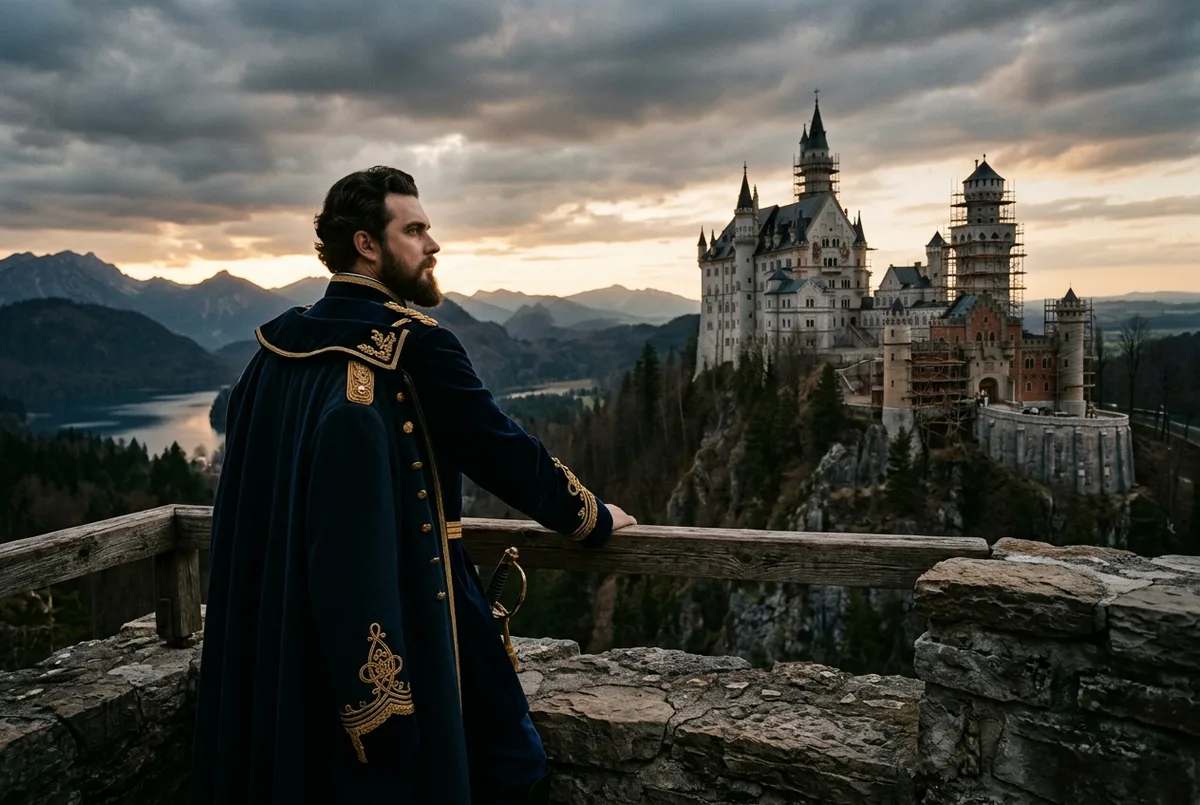
Neuschwanstein Castle’s history is really the story of one man: King Ludwig II of Bavaria, who began building it in 1869 as a private escape from a role he never fully wanted, and who died in 1886 having seen only a fraction of it finished. Here’s what I’d want you to walk away with before anything else: this castle was never meant to be seen by the public at all. Ludwig built it as a personal fantasy, and it only became the world-famous landmark it is today because of how he died and what happened immediately after. Below I’ll walk through why he built it, what shaped its strange and beautiful design, his final years and mysterious death, and why a private dream palace became a tourist attraction within weeks of his funeral. For the practical side of visiting today, my guide to what to expect inside Neuschwanstein Castle covers the modern tour, my day trip from Munich guide covers getting there, and the full lineup of Neuschwanstein Castle tickets and tours sits on the homepage. Since how much of this history each tour actually shows you varies more than people expect, it’s worth seeing how much of Ludwig’s castle each tour actually takes you through before you choose one.
 Ready to see prices? Fussen to Neuschwanstein Castle Scenic Walking Tour, from $50.3 See times
Who was King Ludwig II, and why does he matter here?
Ludwig II became King of Bavaria in 1864 at just 18 years old, and he never took naturally to the political side of the job. He preferred art, music and architecture to court politics, and he used his personal wealth, not state funds, to build the castles he’s remembered for today.
I would push back on the popular “Mad King Ludwig” label a little here. He was eccentric and increasingly reclusive, certainly, but the castle itself is the work of a serious patron of architecture and music, not a disordered fantasy thrown together on a whim. Understanding that distinction changes how you read the building once you’re standing inside it.
Why did Ludwig build Neuschwanstein in the first place?
He wanted a private retreat that reflected his own romantic vision of medieval kingship, built on the ruins of two older castles above his family’s childhood home, Hohenschwangau, with sweeping views over the Alpsee and the surrounding mountains.
I would describe his motive less as “showing off” and more as genuinely withdrawing from a public role he found uncomfortable. Neuschwanstein was his retreat from Munich court life and the modern world creeping into it, not a palace built to impress foreign dignitaries. My Hohenschwangau Castle guide covers the older, lived-in royal residence just down the hill, where Ludwig actually spent his childhood.
Want a closer look? Fussen to Neuschwanstein Castle Scenic Walking Tour, from $50.3 See timesHow much did Richard Wagner’s operas shape the castle’s design?
Heavily. Ludwig was an obsessive patron and admirer of composer Richard Wagner, and several interior rooms, most notably the Singers’ Hall, draw directly on Wagnerian opera themes and medieval Germanic legend, particularly the story of the swan knight Lohengrin.
I would call this the single most important thing to know before stepping inside. The murals, the themed rooms and even the castle’s swan motifs only make sense once you understand that Ludwig wasn’t decorating a home, he was building a physical stage set for the myths and music he loved most.
Who actually designed Neuschwanstein, architecturally speaking?
No single architect saw the project through from start to finish. Eduard Riedel drew up the initial plans working closely with Ludwig’s own sketches, Georg von Dollmann took over as the design grew more ambitious, and Julius Hofmann oversaw the final phase after Dollmann’s death in 1886, the same year as Ludwig’s own.
I would give Ludwig himself more credit as the project’s actual creative director than most casual accounts do. He corresponded constantly with his architects, rejected designs that didn’t match his vision, and pulled heavily from stage-set designer Christian Jank’s romantic illustrations rather than conventional castle-building precedent. The result looks the way it does because a king with strong opinions and Wagnerian taste kept overruling his own professionals.
Ready to see prices? Neuschwanstein Castle Skip-the-Line Tickets with Audio Guide, from $50.19 See timesWhat do the castle’s swan motifs actually mean?
Swans appear throughout Neuschwanstein, from carved details to painted murals, and they’re not decorative filler. “Schwangau,” the region’s own name, translates roughly to “swan region,” and the swan was already a symbol tied to Ludwig’s family through Hohenschwangau Castle nearby. Richard Wagner’s opera Lohengrin, about a mysterious knight who arrives by swan-drawn boat, deepened the connection further.
I would pay closer attention to this motif than most visitors do on a first pass, since it’s one of the clearest threads tying the building’s design directly back to Ludwig’s personal obsessions rather than generic medieval styling. Once you notice the swans, you start noticing just how personal and specific every room’s theme actually is.
Want a closer look? Fussen to Neuschwanstein Castle Scenic Walking Tour, from $50.3 See timesHow long did construction actually take, and was the castle ever finished?
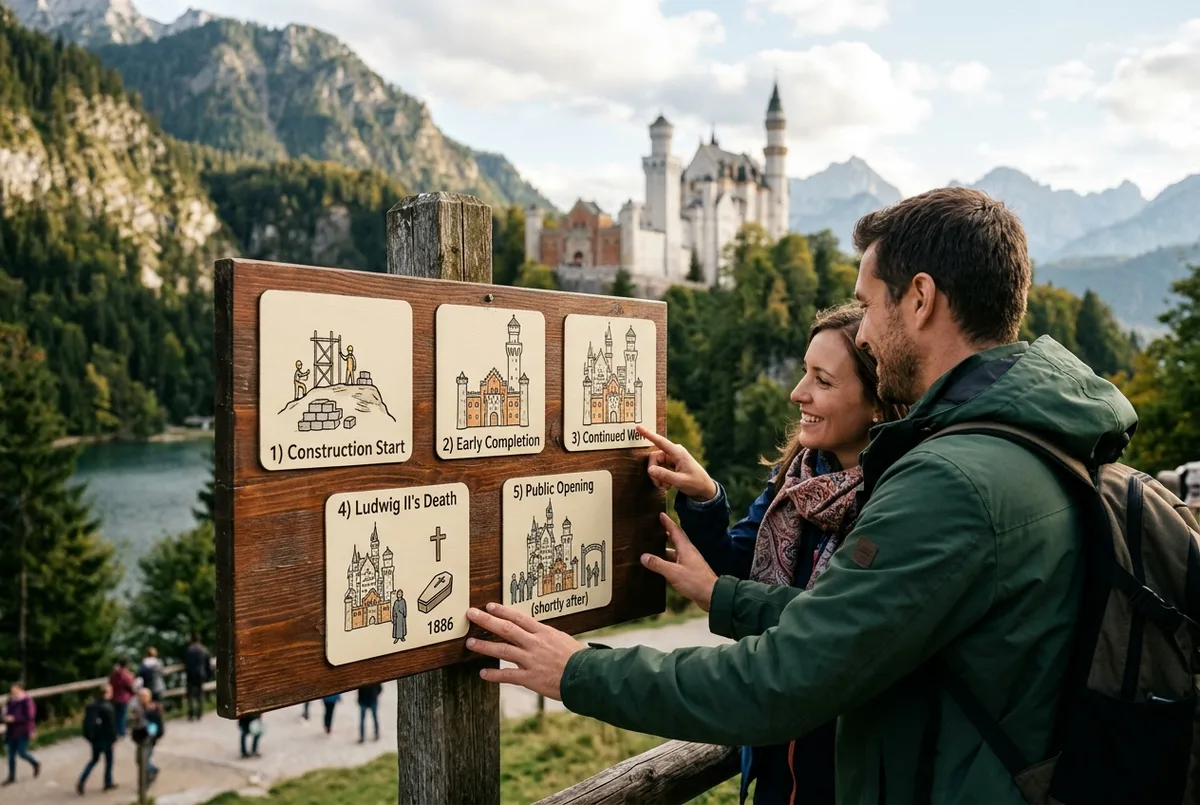
Construction began in 1869 and continued for the rest of Ludwig’s life, yet the castle was never completed. Only about a third of the planned interior rooms were ever finished and furnished; large sections, including an entire planned knights’ house, remained unbuilt or unfinished at his death.
I would keep this firmly in mind on your own visit, since it reframes what you’re actually looking at. The handful of state rooms open to visitors today are genuinely the finished, polished sections, not a disappointing sample of something grander. My what to expect inside guide covers exactly which rooms made the cut.
Short on time? Neuschwanstein Castle Full-Day Trip from Munich, from $79.47 See timesWhat actually happened to King Ludwig II, and how did he die?
In June 1886, Bavarian ministers, citing his erratic behavior and mounting debts from his building projects, had Ludwig declared mentally incapacitated and removed from power. Days later, he was found dead in Lake Starnberg along with his physician, in circumstances that remain genuinely disputed to this day.
I would resist any version of this story that claims certainty either way. Suicide, an accident during an escape attempt, and even foul play have all been seriously proposed by historians over the decades, and the honest answer is that nobody knows for certain what happened that night. That lingering mystery is a real part of why the story still fascinates people more than a century later.
Ready to see prices? Neuschwanstein Castle Skip-the-Line Tickets with Audio Guide, from $50.19 See timesWhy did the castle open to the public so quickly after his death?
Remarkably, within about six weeks of Ludwig’s death, the Bavarian royal family opened Neuschwanstein to paying visitors, largely to help recoup the enormous personal debts Ludwig had run up building it.
I find this one of the more striking turns in the whole story. A castle built explicitly as a private sanctuary, somewhere Ludwig deliberately kept away from public view during his life, became one of Europe’s most visited buildings almost immediately after his death. The irony is hard to overstate, and I think it’s worth sitting with before you visit.
Want a closer look? Fussen to Neuschwanstein Castle Scenic Walking Tour, from $50.3 See timesDid Neuschwanstein really inspire Disney’s fairy-tale castles?
It’s one of several real architectural influences on Walt Disney’s Sleeping Beauty Castle, alongside French châteaux like Chambord, rather than a direct copy of any single building. The resemblance is visual and thematic, not a literal blueprint.
I would treat this as a fun, mostly true detail rather than the castle’s main claim to fame, since the connection gets oversimplified online constantly. My dedicated Disney myth-versus-fact page untangles exactly where the comparison holds up and where it doesn’t.
Short on time? Neuschwanstein Castle Full-Day Trip from Munich, from $79.47 See timesWhat makes the Throne Hall so unusual?
The Throne Hall is built in a Byzantine style more reminiscent of a church than a royal reception room, with a domed ceiling, gold mosaic floor, and a semicircular apse where the throne itself was meant to sit. Ludwig died before the throne was ever actually installed, so the space you see today is, fittingly, another unfinished centerpiece.
I would slow down in this particular room more than any other on the tour. It’s the clearest single example of how Ludwig blended religious, artistic and royal symbolism into something that was never really about ruling at all, and the absence of the throne itself tells its own quiet part of the story.
Ready to see prices? Neuschwanstein Castle Skip-the-Line Tickets with Audio Guide, from $50.19 See timesWhy did Ludwig have an artificial grotto built inside the castle?
Tucked between two rooms is a small artificial cave, complete with stalactite-style decoration and, originally, colored lighting, built purely for atmosphere and inspired by the grotto scene in Wagner’s opera Tannhäuser.
I would call this detail one of the clearest windows into how Ludwig actually thought. Most monarchs commissioned grand halls to project power. Ludwig commissioned a fake cave inside his own castle because an opera scene moved him. That’s a genuinely different kind of ambition, and I think it says more about who he was than any state portrait could.
Want a closer look? Fussen to Neuschwanstein Castle Scenic Walking Tour, from $50.3 See timesHow does Neuschwanstein compare to Ludwig’s other castles?
Ludwig built or significantly expanded three major projects in his lifetime: Neuschwanstein, the smaller and more intimate Linderhof Palace, and the opulent, Versailles-inspired Herrenchiemsee, which, like Neuschwanstein, was also left unfinished.
I would genuinely recommend seeing at least one of the other two if your trip allows it, since each one reveals a different side of the same obsession, and Linderhof in particular pairs naturally with a Neuschwanstein day trip. My comparison of Neuschwanstein against Ludwig’s other Bavarian castles breaks down how each one differs and which combination suits which traveler.
Short on time? Neuschwanstein Castle Full-Day Trip from Munich, from $79.47 See timesWhy does this history still matter for a modern visitor?
Because it changes what you’re actually looking at once you arrive. Knowing that the rooms you’ll see were a king’s deliberate stage for his favorite myths, built and abandoned mid-dream, adds genuine weight to a visit that could otherwise feel like just another photogenic stop on a Bavaria itinerary.
I would read at least this much backstory before you go rather than after, because it reshapes the short 30-minute tour from “a nice old building” into something closer to walking through one man’s unfinished obsession. That context is, in my view, worth more than any extra minute inside the rooms themselves.
Ready to see prices? Neuschwanstein Castle Skip-the-Line Tickets with Audio Guide, from $50.19 See timesHow was Ludwig actually seen by ordinary Bavarians, then and now?
During his lifetime, Ludwig was genuinely popular with the Bavarian public even as his government grew frustrated with his spending and his withdrawal from public duties. He rarely appeared at official functions in his later years, yet ordinary people largely saw him as a romantic, misunderstood figure rather than the reckless spendthrift his ministers made him out to be.
I would say that public affection has only grown since his death, not faded. Modern Bavaria treats Ludwig less like a cautionary tale about royal debt and more like a local folk hero, the dreamer-king who gave the region its most famous landmark almost by accident. Statues, street names and the castle’s own gift shop all lean into that affectionate version of the story rather than the unflattering one his own ministers pushed in 1886.
Want a closer look? Fussen to Neuschwanstein Castle Scenic Walking Tour, from $50.3 See timesWhat’s the one historical detail most visitors miss?
That the castle’s iconic exterior, the part everyone photographs from Marienbrücke, was largely complete by the time Ludwig died, while much of the interior behind that striking facade never was. The building you see from outside is more finished than the one you’d actually walk through.
I would point this out to anyone expecting the inside to match the outside’s grandeur room for room. It doesn’t, and knowing that in advance saves you from a very specific kind of disappointment that catches a lot of first-time visitors off guard.
Short on time? Neuschwanstein Castle Full-Day Trip from Munich, from $79.47 See timesWho runs Neuschwanstein Castle today, and who pays for its upkeep?
The Bavarian Palace Administration, the same state body that manages Ludwig’s other castles, has looked after Neuschwanstein since shortly after his death. Upkeep is funded largely through ticket revenue rather than general taxpayer funds, which is a fairly direct continuation of the original reason the castle opened to the public so quickly in 1886.
I find it fitting, in a slightly bittersweet way, that the castle Ludwig built to escape public life now pays for its own preservation entirely through the public visiting it. It’s one of the clearer examples I know of a historical irony that genuinely still plays out today, every time a ticket gets sold at the Hohenschwangau counter.
Ready to see prices? Neuschwanstein Castle Skip-the-Line Tickets with Audio Guide, from $50.19 See timesMy take on why this story still resonates
A king who built a private fantasy, never truly lived to see it finished, died under circumstances nobody has ever fully resolved, and ended up giving the world one of its most recognizable buildings almost by accident. I think that combination, obsession, mystery and unintended legacy, is exactly why Neuschwanstein still draws millions of visitors a year.
I would not visit this castle purely for the architecture. I would visit it for that story, with the building as the physical proof that it actually happened. For the official academic account beyond what fits here, the Bavarian Palace Administration’s own history pages, run by the state body that still manages the castle today, are worth a read.
Want a closer look? Fussen to Neuschwanstein Castle Scenic Walking Tour, from $50.3 See timesFrequently asked questions
When was Neuschwanstein Castle built?
Construction began in 1869 under King Ludwig II and continued until his death in 1886, though the castle was never fully completed according to his original plans.
Why did King Ludwig II build Neuschwanstein Castle?
He wanted a private retreat reflecting his romantic vision of medieval kingship, shaped heavily by Richard Wagner’s operas and Germanic legend, built as an escape from his public role rather than to impress visitors.
How did King Ludwig II die?
He was found dead in Lake Starnberg in June 1886, days after being declared mentally incapacitated and removed from power. The exact cause, whether suicide, accident or foul play, has never been conclusively proven.
Is Neuschwanstein Castle the real Disney castle?
Not a direct copy. It’s one of several genuine architectural influences on Disney’s Sleeping Beauty Castle, alongside French châteaux, rather than the sole inspiration.
Was Neuschwanstein Castle ever finished?
No. Only about a third of the planned interior was completed and furnished before Ludwig II’s death, and several planned sections were never built at all.
What inspired the design of Neuschwanstein Castle?
A mix of medieval legend, Richard Wagner’s operas, and Ludwig II’s own romantic idea of kingship, translated into architectural drawings largely developed from stage-set illustrations rather than conventional castle precedent of the era.
Can you visit the room where King Ludwig II actually died?
No. Ludwig died at Lake Starnberg, roughly 50 kilometers from the castle, not inside Neuschwanstein itself, so the room associated with his death isn’t part of the site at all.
Short on time? Neuschwanstein Castle Full-Day Trip from Munich, from $79.47 See times